#15 · Argentina
Journey #15 – Argentina
15 September 2013
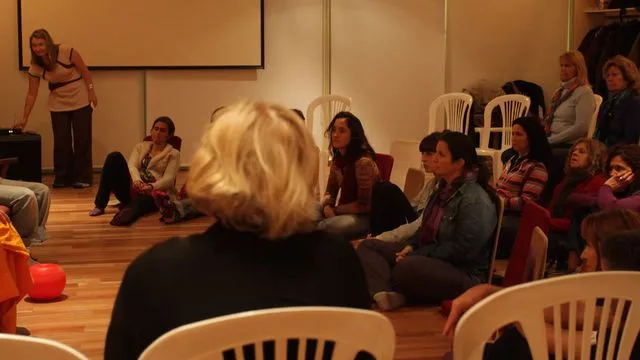
I spent the Buddhist lent of 2013 in Peru, and from there I made short trips to neighbouring countries. After Chile in August, I went to Argentina in September. It was my first time in the country, and the first time Peace Revolution had ever organised a Peace On Demand event there.
The whole visit came down to two people. Diego and Ana, a young married couple from Buenos Aires, had finished the Peace Revolution training only in June. Right after, they began looking for ways to invite a monk to their country. They spent the next three months contacting companies, studios and community groups, and when I landed they had a full schedule waiting for me.
Date: 10 – 15 September 2013
Participants: 348
| Date | Session | Place | People |
|---|---|---|---|
| 10 Sep | Banco Columbia | Buenos Aires | 10 |
| 10 Sep | Desplegarte | Buenos Aires | 28 |
| 11 Sep | Jupapurá | Lomas de Zamora | 70 |
| 12 Sep | Dharam | Buenos Aires | 23 |
| 12 Sep | Shiatsunuad | Buenos Aires | 38 |
| 13 Sep | Centro Shakti | La Plata | 46 |
| 13 Sep | Fundación Columbia | Buenos Aires | 34 |
| 14 Sep | Morning session | Rosario | 22 |
| 14 Sep | Gym of Román | Rosario | 67 |
| 15 Sep | Espacio Rewe | Vicente López | 10 |
| Total | 348 |
Summary
In six days we held ten sessions in four cities, and almost 350 people sat down to meditate with us. Most of them had never heard of Peace Revolution. The host venues were a bank, a foundation, a gong and yoga studio, a shiatsu center, an art space and a martial arts gym.
The pattern repeated everywhere. We expected a small group, far more people turned up than anyone had registered, and the room ended up with people sitting in corridors and on the floor. At Jupapurá, 80–90% of the room raised a hand to say they had seen a bright sun, moon or star in the center of the body. In Rosario, a whole gym did.
None of this would have happened without Diego and Ana, who organised, drove, translated and cooked for a team of monks for a week, mostly on a few hours of sleep.
A different kind of South America
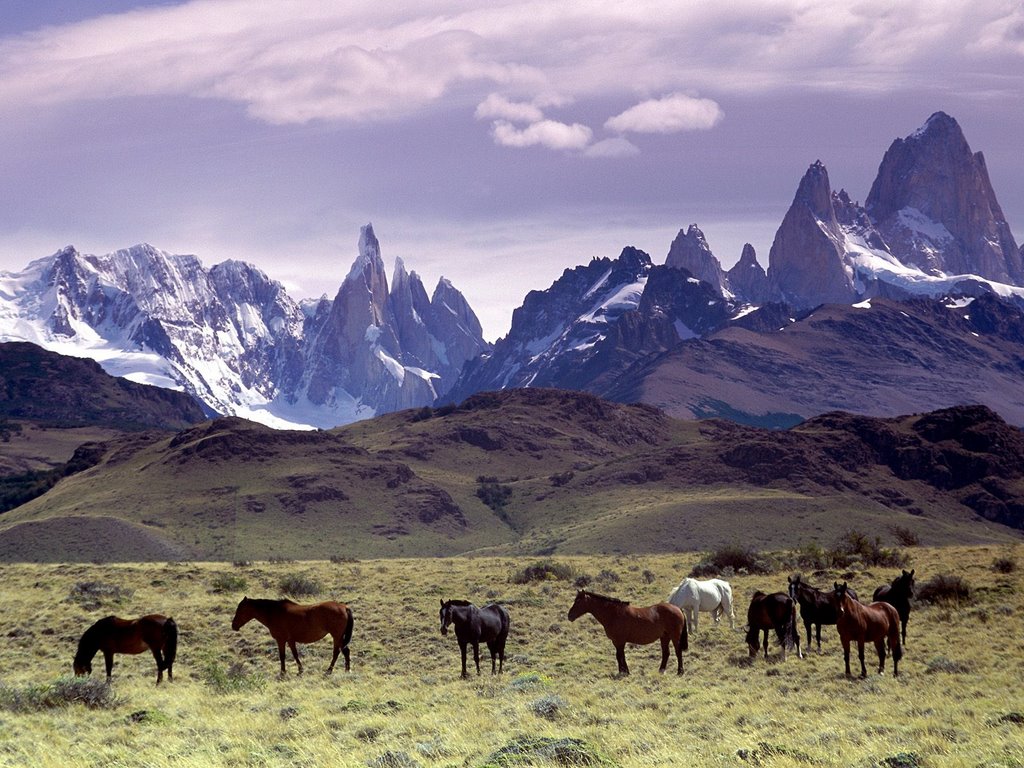
Argentina is the second largest country in South America and the eighth largest in the world. About 97% of its people are descended from Europeans, so it feels closer to Chile than to Peru, where I had been living, or Bolivia, where indigenous people are the majority. Almost everyone lives in or around the capital, Buenos Aires. Outside the city there are open grasslands for cattle, and then the Andes along the western border.
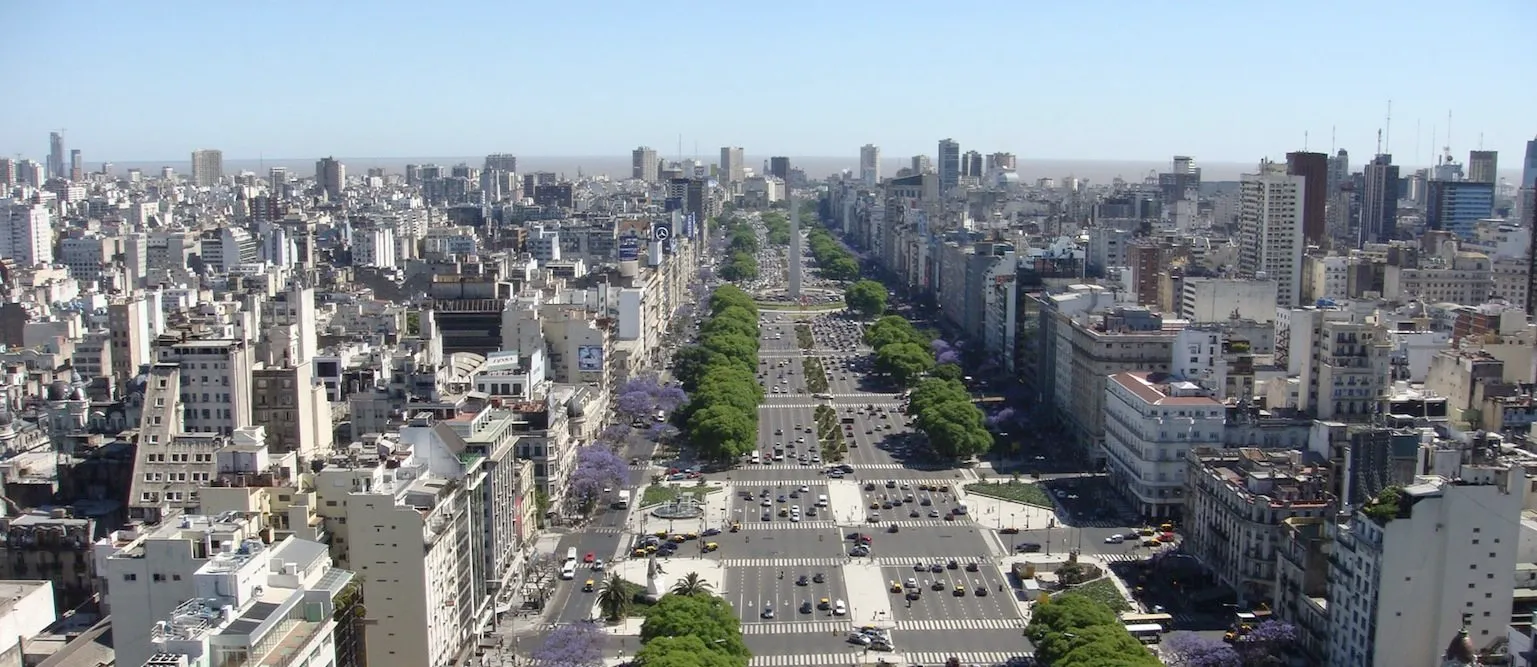
We had worried about the cold. Winter in Argentina is normally colder than in Peru, so the team was a little anxious before the trip. When the plane landed it was 32 degrees. The usual temperature at that time of year is 10 to 15, and the heat wave was so strange that it was on the evening news. Nobody could explain it, and it set the tone for a week of surprises.
Diego and Ana
Diego was a lawyer with a bright future at one of the best-known law firms in the country. Ana worked in finance at another well-known company. They had married young, and after a few years both of them noticed they were being pulled into a whirlpool of competition, with every promotion and every colleague making the water faster. So they quit. Diego told me that if he was going to sail out onto the ocean, he wanted to be the captain of his own ship instead of leaving the wheel to someone else. They gave up good salaries and what looked like secure careers, and went looking for a path toward peace.
That search led them to Peace Revolution. Since June they had been working on this visit, and they took care of everything. We stayed at Diego’s home in Lomas de Zamora, about the same distance from the center of Buenos Aires as Pathum Thani is from Sukhumvit in Bangkok. Every morning, before six, they had breakfast ready to offer to the monks, and they did not miss a single day.
During the sessions they split the work between them. Diego was the MC and translated from English to Spanish. Ana handled registration, the materials, and the follow-up, encouraging everyone who came to sign up on the Peace Revolution website. On top of that, Diego was our driver. The sessions were far from each other and from the house, so he drove at least a hundred kilometres every day, and on some days more than five hundred. After the last session of the night he would sit down and do the accounts and the attendance count, so he was rarely in bed early.
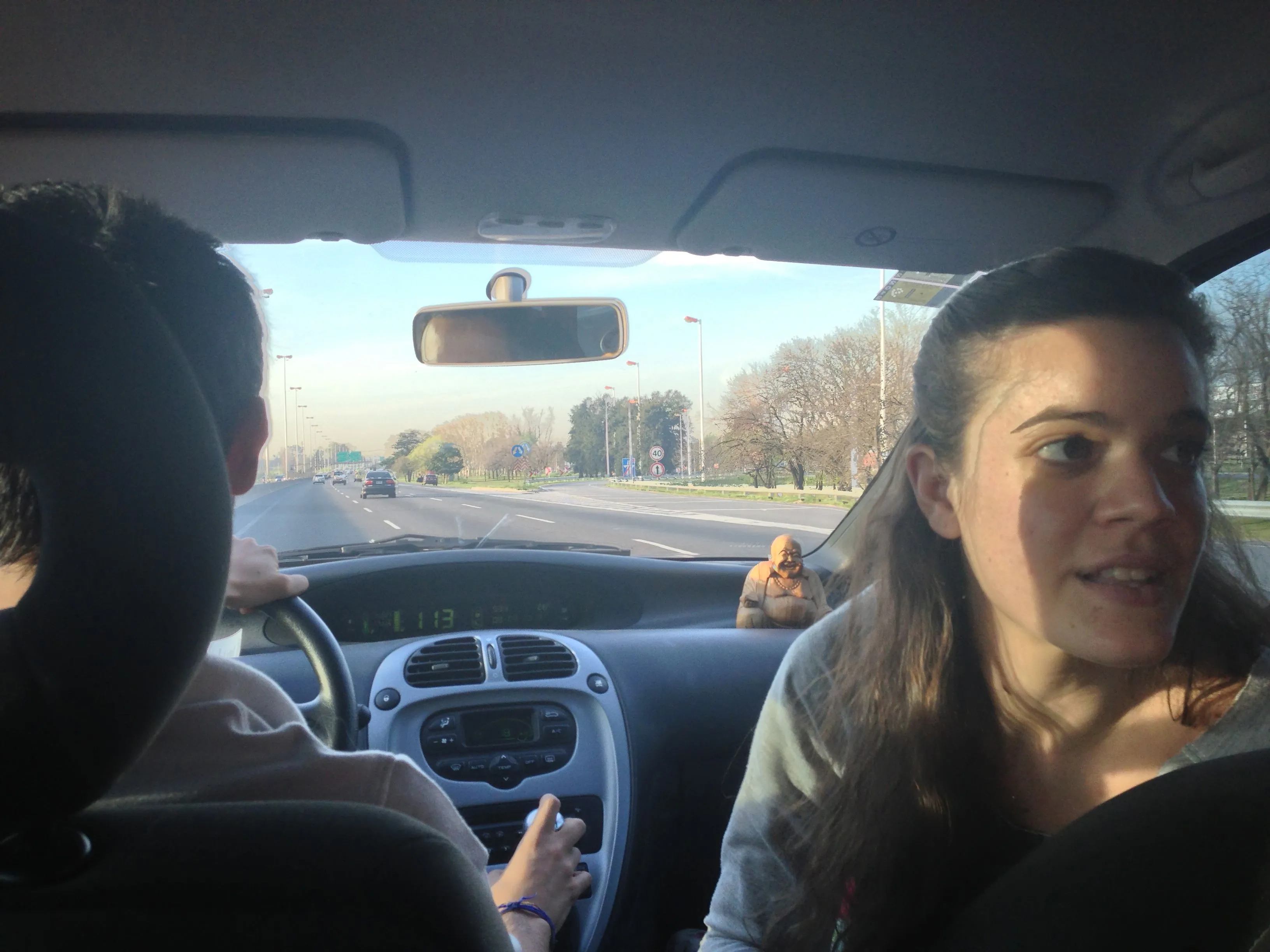
10 September: a bank and an art space
Banco Columbia
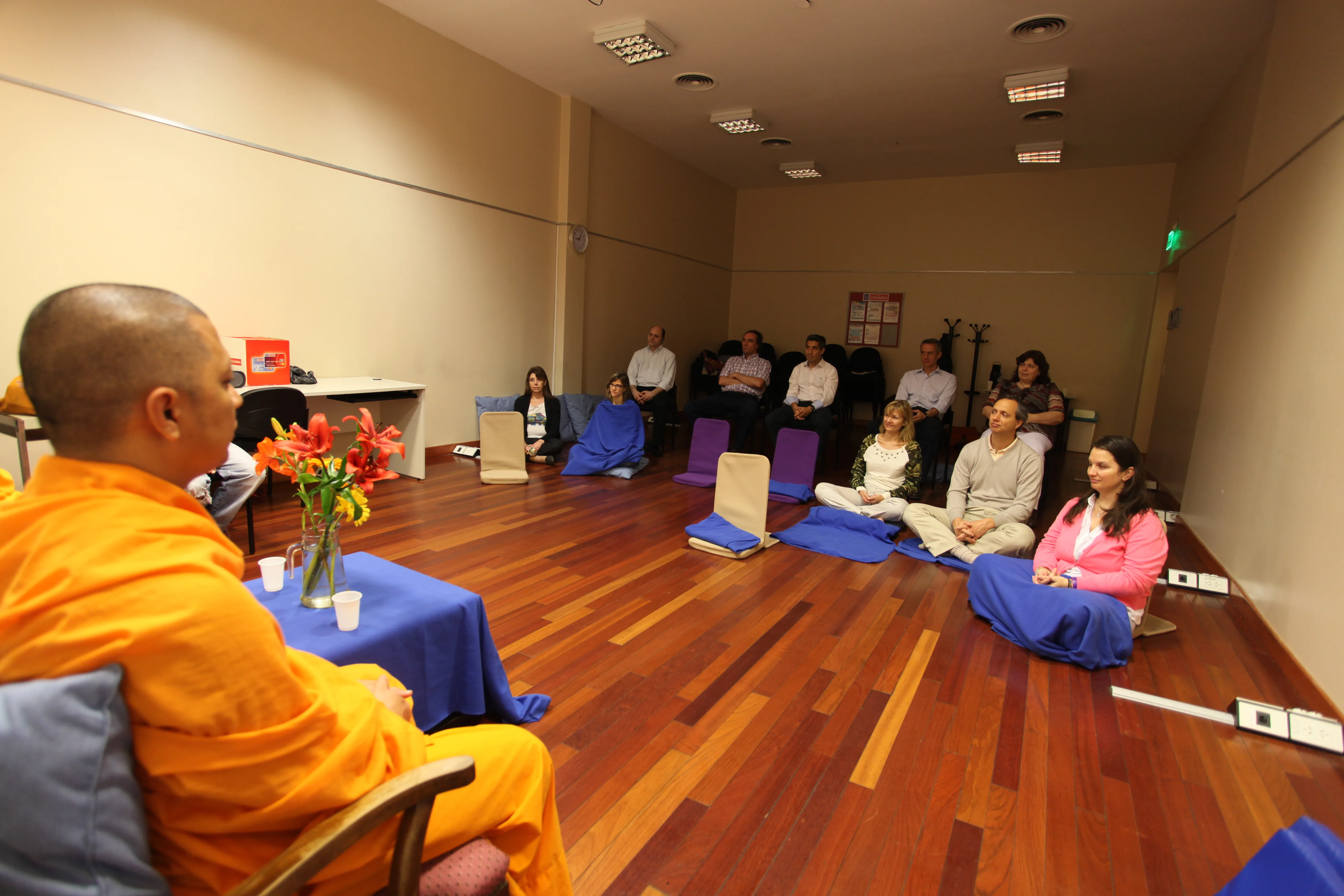
Our first session was in an unusual place: the head office of Banco Columbia, a local bank in Buenos Aires. Some of the staff had formed a small meditation group, and the bank had given them a small room just for practice. What impressed me most is that the owner of the bank comes and leads the group himself once a week. He is convinced that the economy and the mind have to develop together, and I have not met many bank owners who would say that and act on it.
We arrived late because of the traffic, so we had no time to hang up our banners and started almost straight away. Ten people came. Most of them already meditated, usually by following the breath (anapanasati) or with the Goenka style of vipassana, and Goenka had only recently passed away. That meant I did not have to explain much. I introduced the center of the body and they began.
Afterwards several people were surprised that 30 minutes had felt like ten. They felt light, open and as if floating. Two women saw a bright moon in the middle of the body.
Some of the staff also volunteer at the bank’s foundation, Fundación Columbia, which invites Argentines to look for their own spiritual path from within. Over the years they have hosted well-known speakers, including Deepak Chopra. We would be visiting them again at the end of the week.
Desplegarte
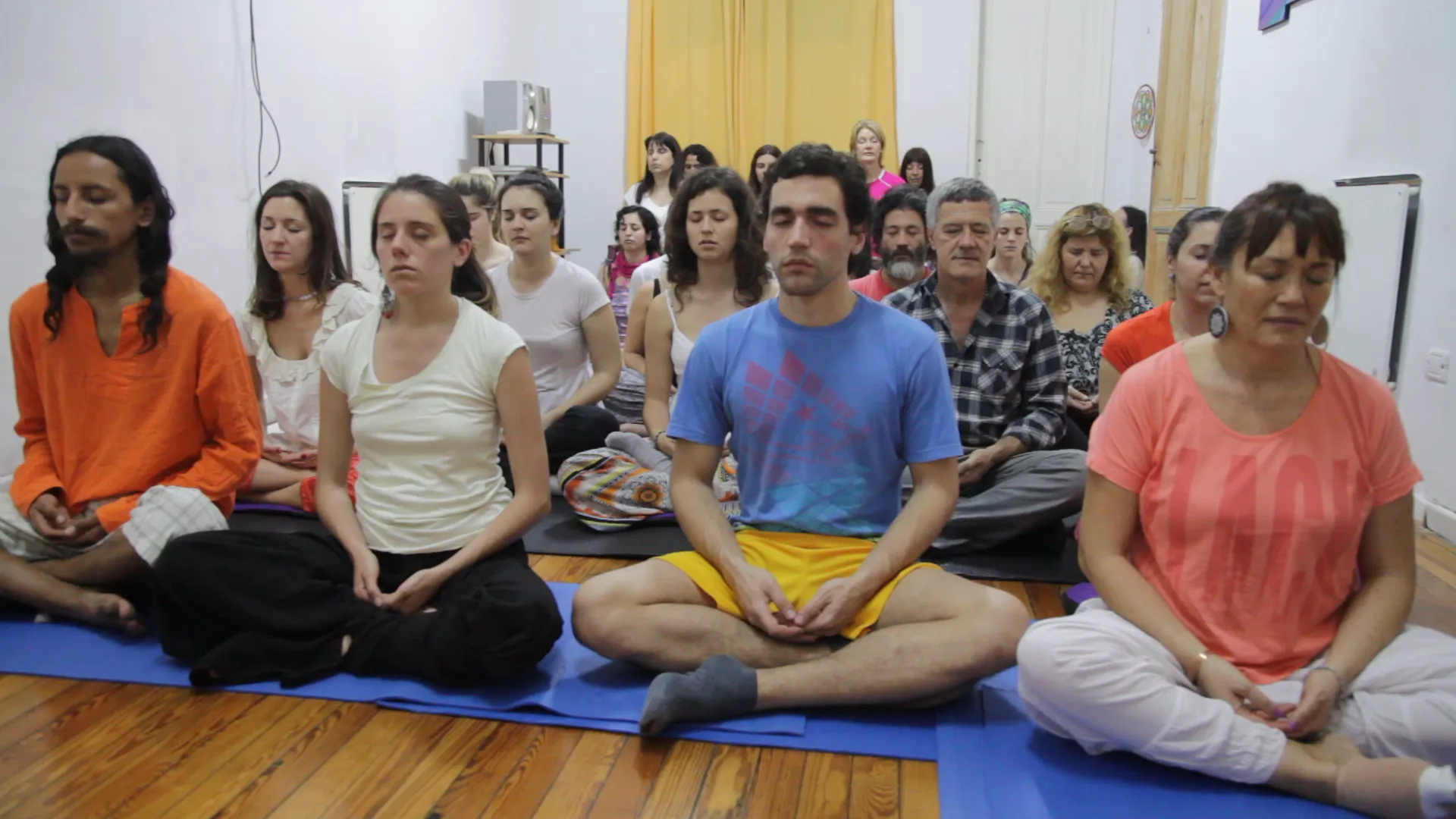
That evening we went to Desplegarte, a group for people who love art. Ten people had signed up. Thirty almost came. Diego explained that most Argentines do not like to follow rules, and that includes signing up in advance, so they just turn up. Most were young, between 20 and 30, and the room was full. Diego’s parents came too, and his mother, who was in pain from a leg problem, still saw the moon shining brightly in her belly.
Almost everyone smiled afterwards. They said they felt open, light and floating, and many had lost all sense of time, so the 40 minutes had passed very quickly. Four or five women (most of the people who came to the sessions in Argentina were women) said they had seen a bright sun in their belly and felt energy spreading out from the center of the body. One Peace Rebel, a volunteer who had signed up for the special operations program, came to help. One man liked the session so much that he came back to another one later in the week.
11 September: Jupapurá
Jupapurá is a space in Lomas de Zamora, the neighborhood where Diego and Ana had lived before. We had a feeling it would be popular, but the room was small, about the size of the meditation room we use in Thailand, and only 20 people had registered. I thought that was about right.
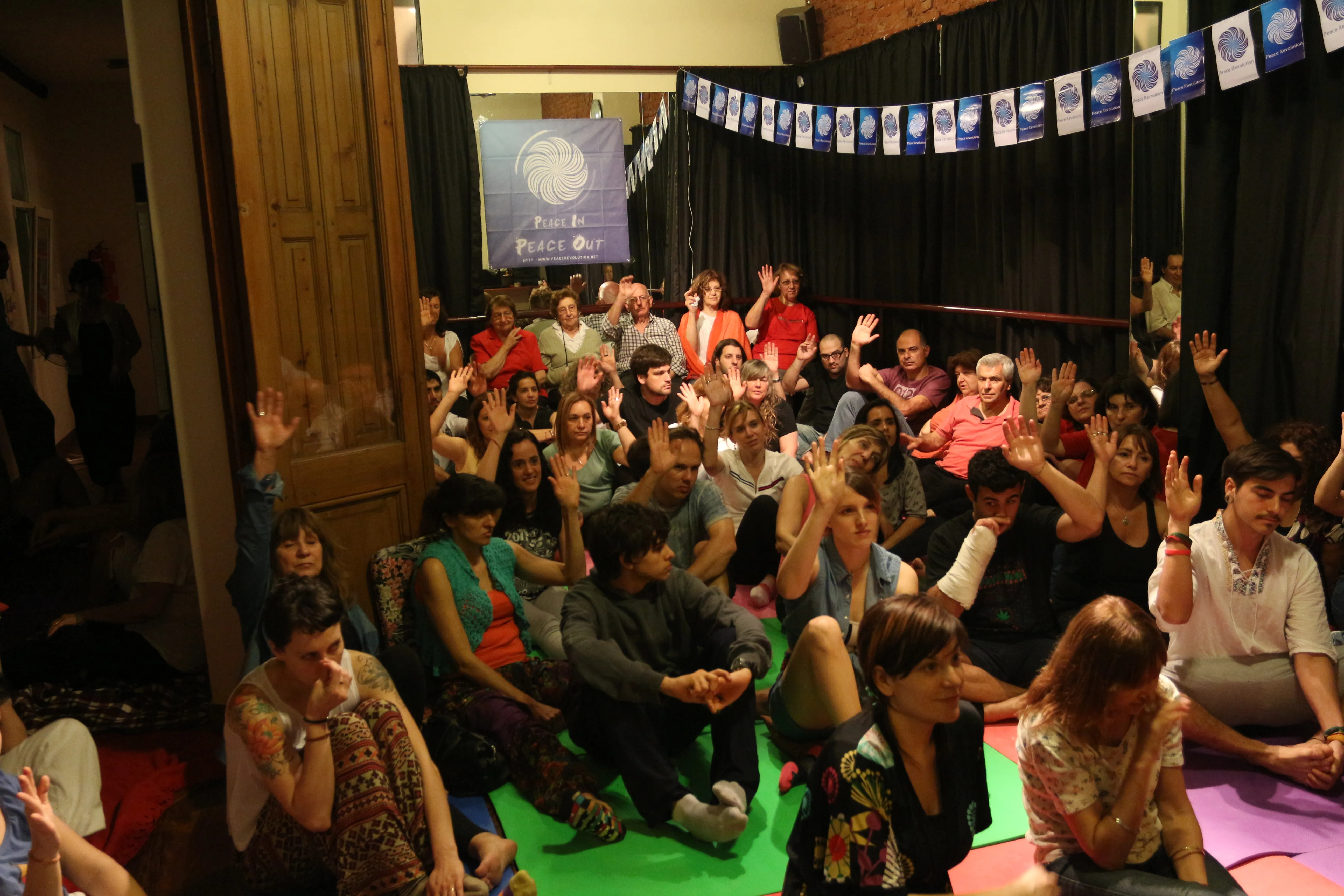
The day before the session, people began texting to say they would come, and bring friends. By 19:00 there were 70 people. Some sat in the narrow corridor, others in the tiny rooms next to the hall, listening through a sound system and a pane of glass. It was a bit uncomfortable for them, though nobody left, and the cameraman could not even get in to film because the whole corridor was packed.
The results were excellent. When I asked who could see a bright sun, moon or star in the center of the body, 80–90% of the room raised a hand. Some felt energy spreading out from the center, and they were so happy that the team wondered why Argentines seemed to smile so easily. Diego and Ana told us the truth: they don’t normally smile this much. These people were just feeling something real.
One woman said that the most important thing is the moment the mind stops, and that absolute silence will bring happiness to all our lives. She loved the sound of the mantra.
Before we left, a mother and her daughter came up to me. The mother said that she knew a monk lives on the food people offer, and she had brought me something. She handed over a large bag of cooked grains and a bag of sugar. It was a lovely moment, and a very Argentine one: practical, warm and generous.
12 September: two sessions at once
On the third day we split into two teams, with a session at the same time at two different places. Diego and Ana had to separate, but their friends, brothers and sisters and even friends from primary school stepped in to help with registration, setting up the rooms and welcoming guests. It was a pleasure to see how much people loved them.
Dharam
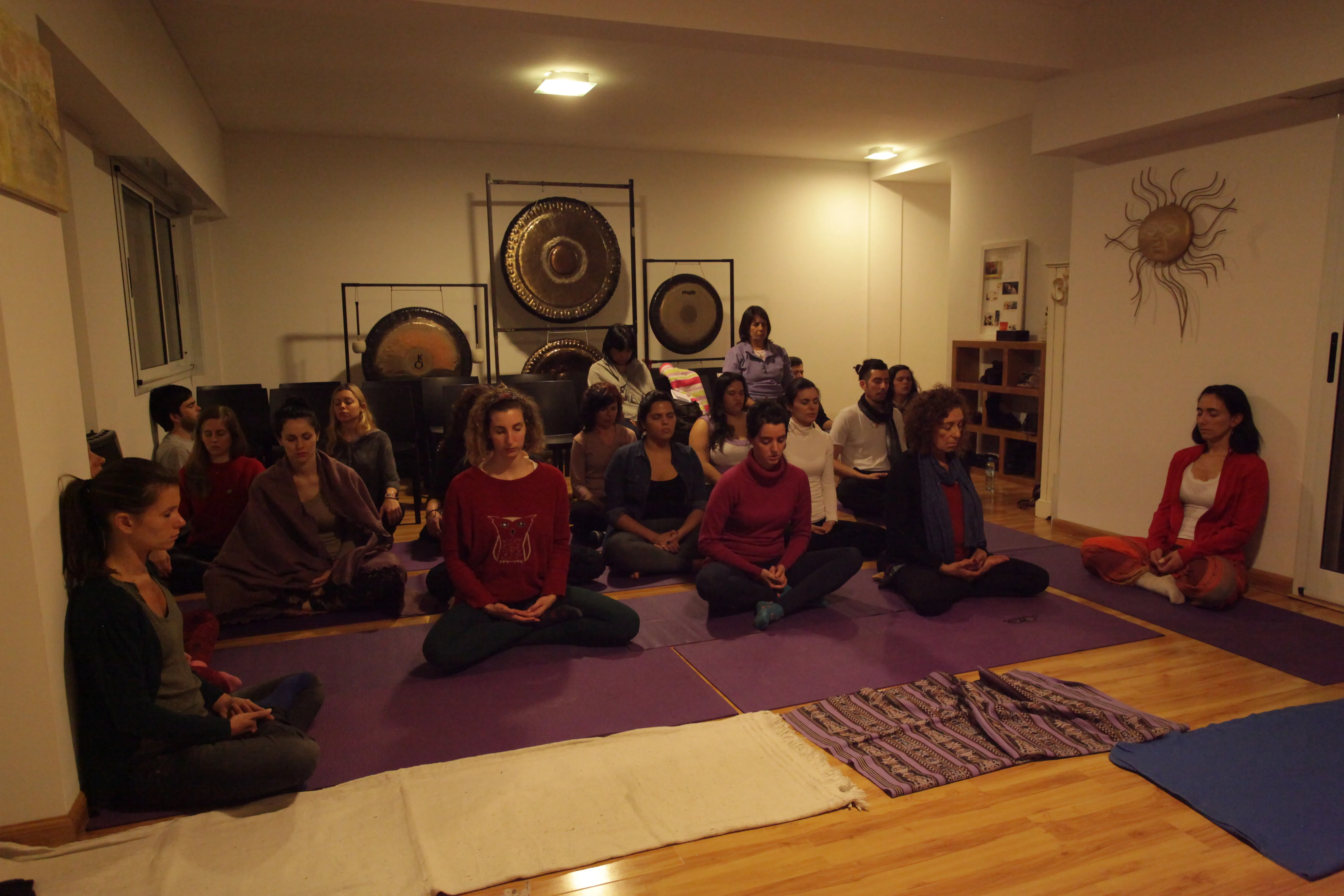
Dharam is a gong and yoga studio. We had a small group of 23, and most people there had meditated before. I explained that the method is quite similar to what they were used to, with one difference: the place we let the mind rest is the center of the body, at the seventh base. They were curious, and since many of them know sound meditation from the gongs, they asked a lot about meditating with sound.
After 40 minutes nearly everyone had the same problem: they could not open their eyes. Most could picture a bright full moon clearly, and some felt energy radiating in every direction. One woman said she was half asleep and half awake, as if dreaming, cool and calm, with a peace she could not describe. Among the group was Ana’s mother, who does yoga already, but said this time it was easy to relax, and it was the first time her mind had been so still. She felt her body disappear, and the moon grew brighter and brighter until it lit up her whole body and expanded outward.
Afterwards I admitted that if I had not felt sorry for Diego, who would have to drive home late again, I would have let them sit for another hour. It was that calm in the room.
The cameraman did not come that night, but a Peace Agent, Juan Martín Camusso, stepped in to help us film and take photos. We learned from it to have a backup for the video person.
Shiatsunuad
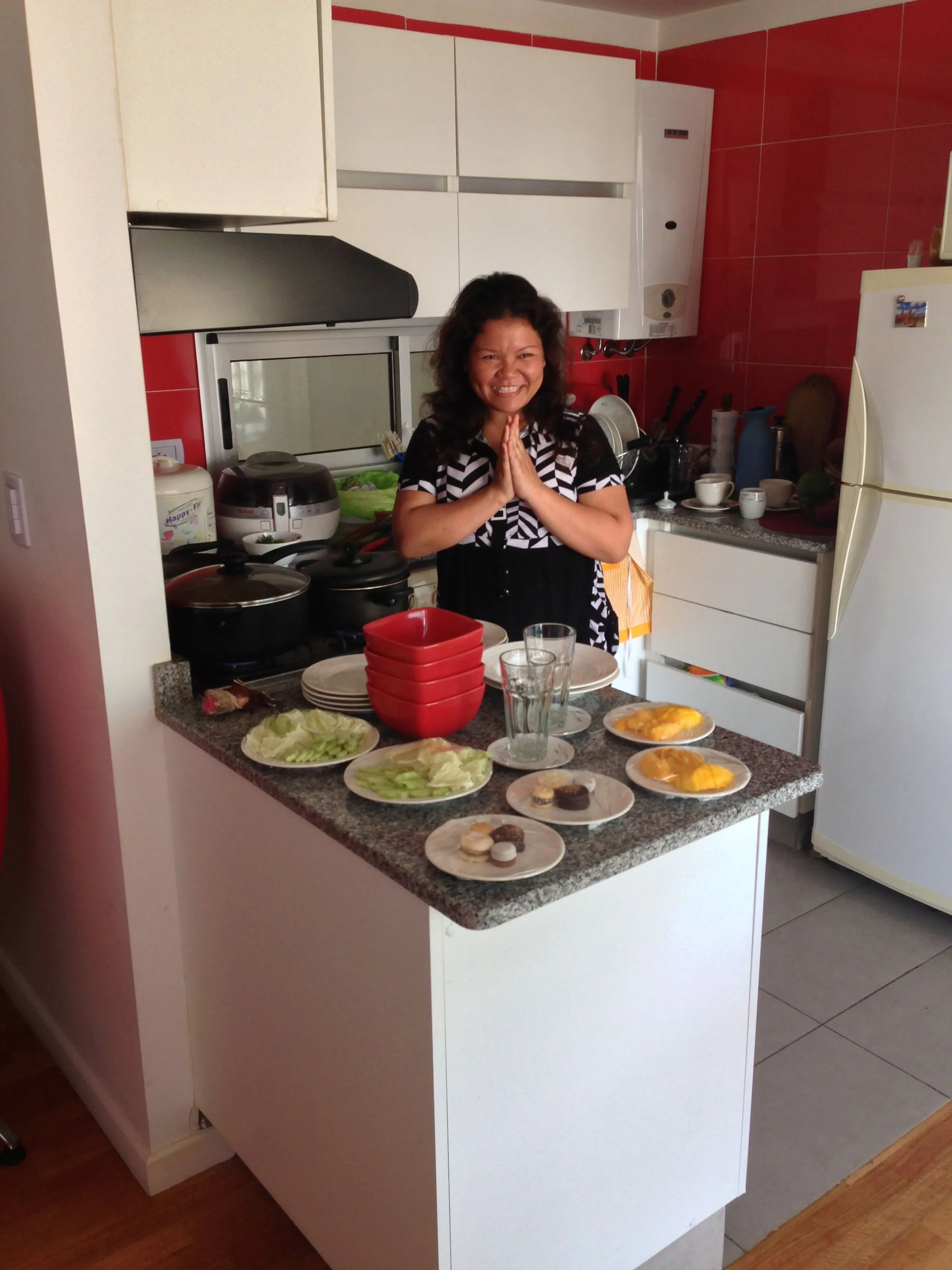
At the same time, LP Prakit led the second group at Shiatsunuad, a shiatsu center, with 38 people. It was the first time we taught in Thai, with Omjai translating into Spanish. She had spent more than two years studying Spanish, with the hope that one day she could be the voice of the monks, and that evening her wish came true. She also helped cook the meal offering for the monks.
The atmosphere felt like walking into a Thai home. The place had many trees, Buddha images of different postures arranged with respect, and the owner and many of the guests could say “sawasdee khrap” as if they had rehearsed. Afterwards everyone had a smile and a story. Some said their body had disappeared, felt light, and wanted to come back.
A psychologist described it well. She said that she stopped feeling her body at all, but her mind kept working. She did not notice time passing, or the ache in her legs. The mantra helped her keep her attention on the inner moon, like being in the dark and finding a light inside that expands in every direction. In the end she felt warmth, love and kindness, and promised herself to meditate every day.
It became something of a trend. The Argentine guests asked to hear the guided meditation in Thai, because the language sounded exotic and mysterious and is rarely heard. Then Omjai translated it to Spanish. For this to work well the translator has to be truly inside the meditation, and Omjai was. Her own advice, which we wrote down afterwards, is that the translator should practice at least once before the session.
13 September: radio, La Plata and a late arrival
The radio interview
The next day we traveled to La Plata, the third largest city in the country. A local radio station invited us for an interview in the afternoon. The host was so impressed with our answers that I was asked to lead a 15-minute meditation live on air, with Diego translating.
The interview ran late, which was the start of a long evening.
Centro Shakti
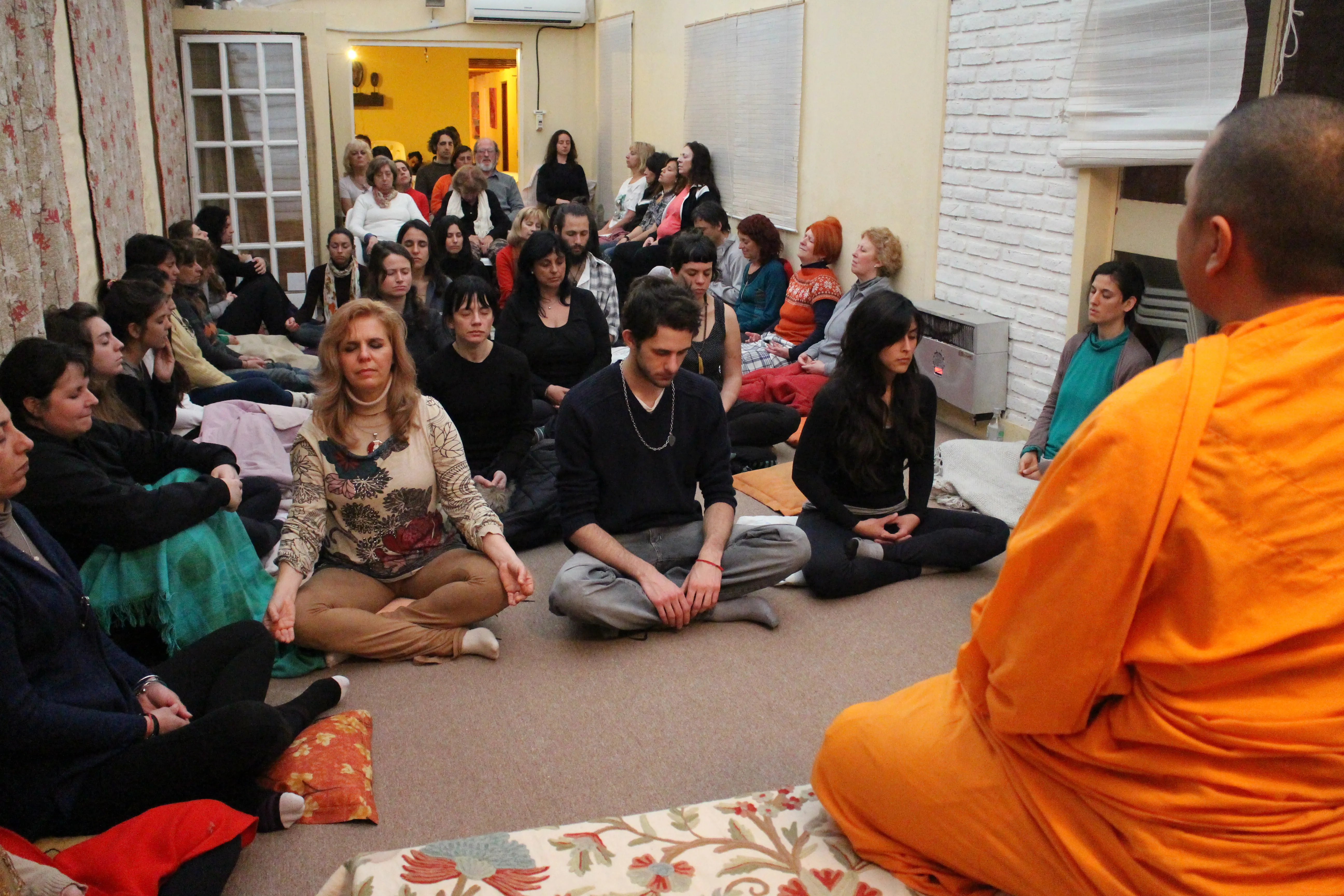
The session at Centro Shakti was organised by the radio host himself. A lot of people signed up, more than the hall could hold. We added chairs, people sat on the floor in every corner, and I guided the meditation in Thai while Omjai translated into Spanish. Nearly the whole room had good results.
Almost everyone there had tried meditating “with sound” before, but today they said they preferred the center of the body, because it made the mind stop more easily. Many of them were fascinated by the life of a monk. They asked so many questions about the Buddhist culture and Peace Revolution that someone asked if they could interview me.
Because the radio interview had overrun, we arrived late and had no time to hang up our banners. It was the second time that week that the banners stayed in the bag.
Fundación Columbia
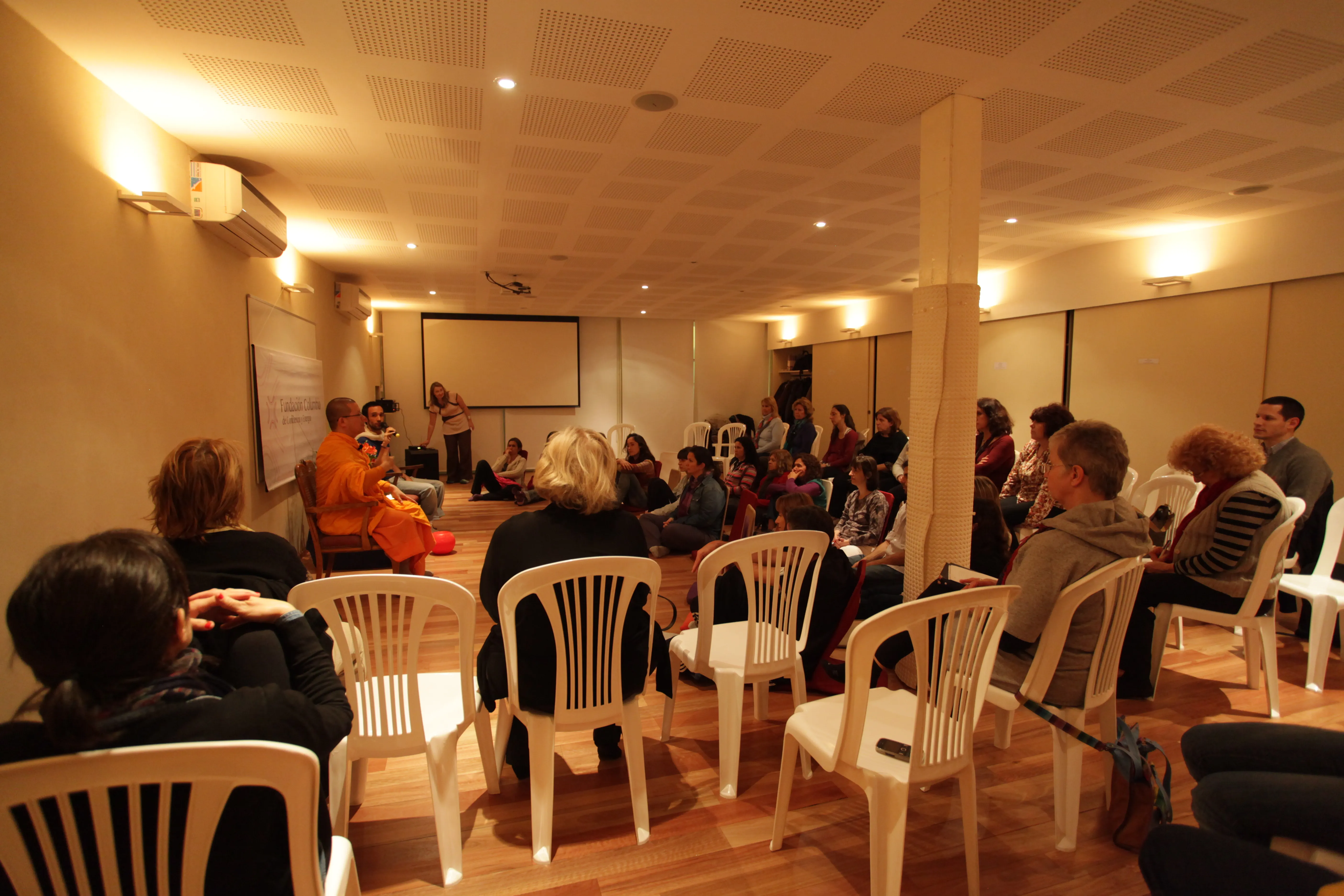
That same evening we were due at Fundación Columbia, the foundation that belongs to the owner of the bank from the first day. Diego had to rush back to Buenos Aires after the La Plata session. Ana is usually the one who navigates, but the street names in Argentina repeat so often that even with her help he took a wrong turn, and we arrived 30 minutes late. The people waiting were not smiling.
So I did not start the usual introduction. Instead I began by talking with them and telling stories, little by little, until the frowns turned into smiles and the smiles turned into laughter. Only then did we sit. The result was remarkable. Almost everyone raised a hand for a bright moon in the belly, with a lot of light spreading out from it. A few people felt as if they had fallen into the center, and rather than being frightened they were happy to drop in.
These people were hungry to learn the truth of life, so I went deeper. I told them that meditation is not only for relaxing and getting rid of stress, but a tool for changing our habits, and in the end for freeing the mind from defilements. Time was up, but nobody wanted to leave. They sat there with wide eyes as if they had never heard any of this before, and I think if we could have stayed, we would have gone through the whole life of the Buddha.
One participant wrote to Diego the next day. She wrote that during the meditation her mind became still. For her, meditation is a path of purity that helps us connect with who we really are, and she had discovered that she is a beautiful light. Once we find peace within ourselves, she said, we want everything around us to be at peace too, and we become ready to change our bad habits. She liked that I had told them not to believe anything but to prove it for themselves. Then she wrote what I think is the best summary of the whole trip: we are only a drop in the ocean, but the ocean would be less without that drop. She added Gandhi’s saying about changing ourselves in the way we want to see the world change.
By the time we got home it was almost midnight. Diego and Ana were visibly worn out after four days, and the next morning he had to drive nearly 300 kilometres to reach Rosario in time for the morning session.
14 September: Rosario
Rosario’s network was built by Román, an Argentine Muay Thai teacher who had come to Thailand to be ordained as a monk through our IDOP program. After he went home, he showed the video of his ordination to everyone in his town, and taught the children basic meditation. He also taught everyone how to behave around monks. As a result, people greeted us with a deep respect I did not expect. Some of the young men, when they were leaving, bowed with their forehead to the ground, the full Thai way.
We held two sessions that day: one in the morning for a group that does yoga and has an interest in eastern culture, and one in the afternoon at Román’s gym.
The morning session had 22 people. Most of them had good experiences but did not ask many questions. In the afternoon, 67 people filled the gym. Since it was a martial arts center, many were men, but many families came as well, so there were children and grandparents as well as young people. The children were interested and asked questions.
I asked who had a bright sun, and the whole room raised their hand. I asked again, because I was not sure they had understood the question. They had. Many added that they could feel energy flowing from the center of the body like waves in every direction.
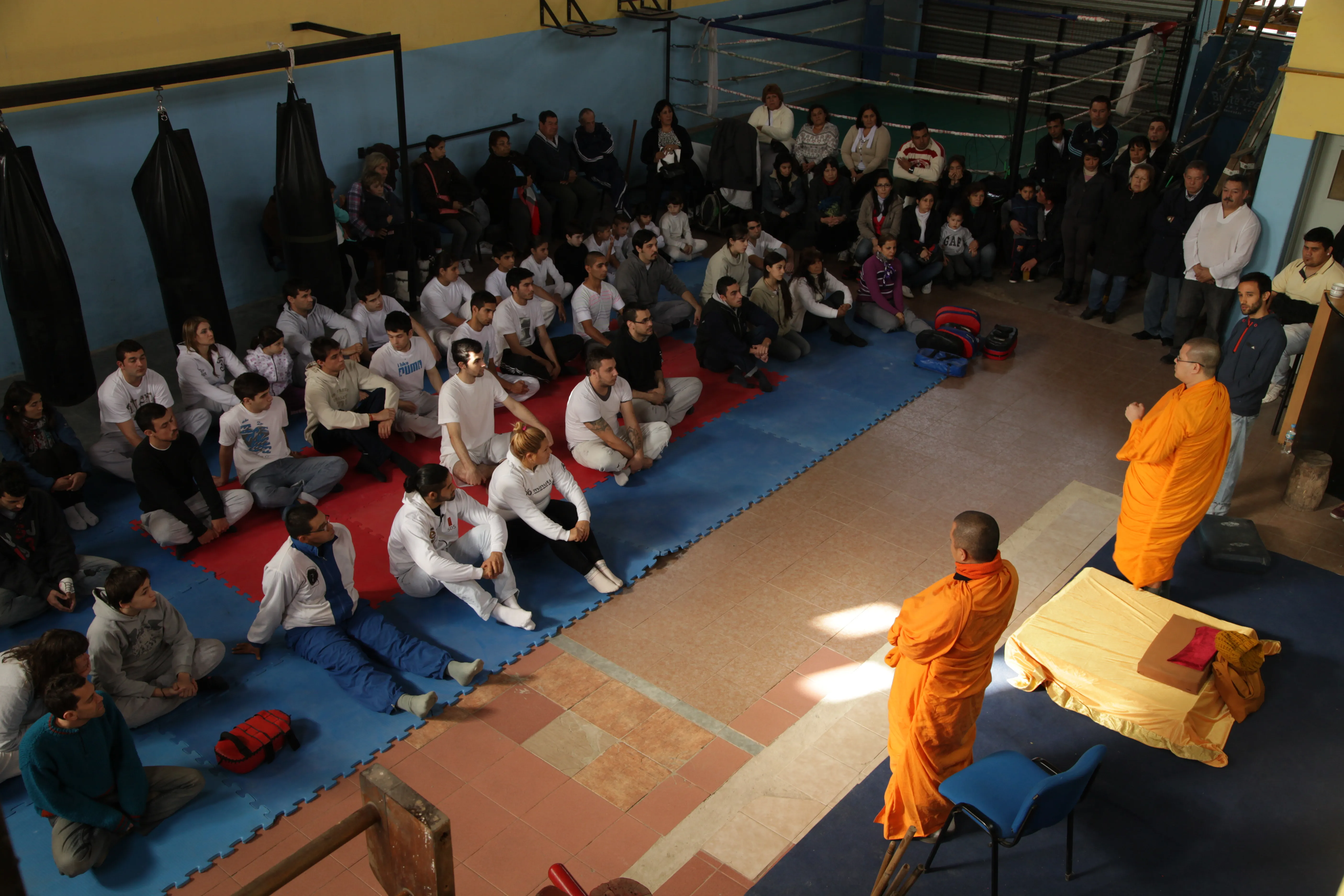
Several of the people there were already members of the Peace Revolution website. One member, hearing that we were coming, brought four friends along. Another, a Peace Rebel named Florencia, brought four friends from Córdoba, 373 kilometres away. They took a bus, and the round trip took the whole day. She told me that she meditates every week with her boyfriend and they talk about it all the time. When she heard that a Buddhist monk was coming to Argentina, she decided that she had to sit with him, and the distance was never a problem. She came for just 40 minutes of meditation, stayed the night in Rosario, and went home the next day. She hoped I would visit Córdoba next time.
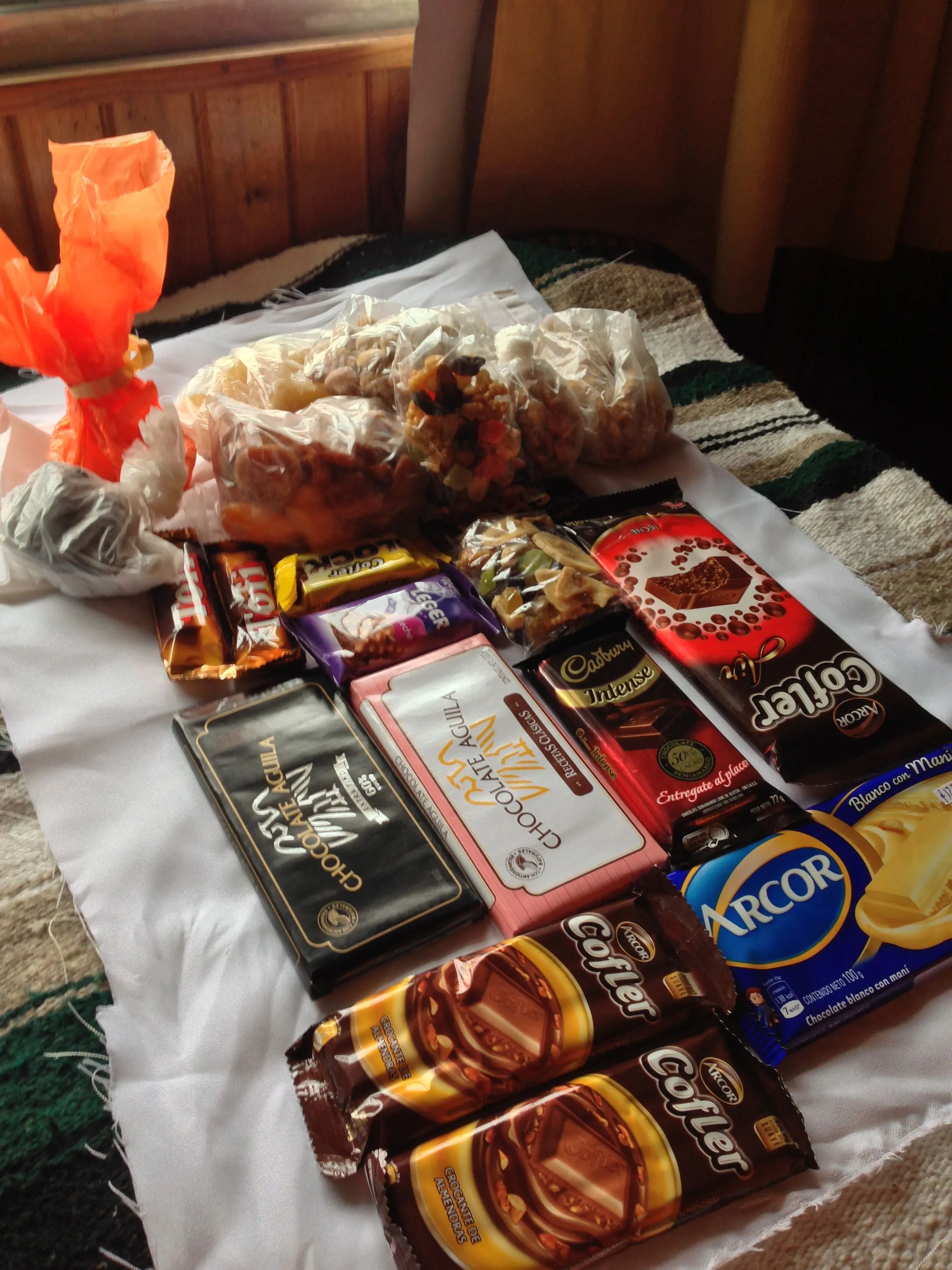
After both sessions, someone came up to give me chocolates, both with and without nuts, wrapped in a white cloth. This must have been Román’s doing again. We were quite touched by it. Someone had taught them well how to offer food to monks.
15 September: a farewell with the family
The last session was a small one, held in the morning at Espacio Rewe in Vicente López, a space where meditation meets art, and the participants were mostly Diego and Ana’s family. It rained, and we had not expected much on a Sunday morning. Ten people came, but those ten sat very well.
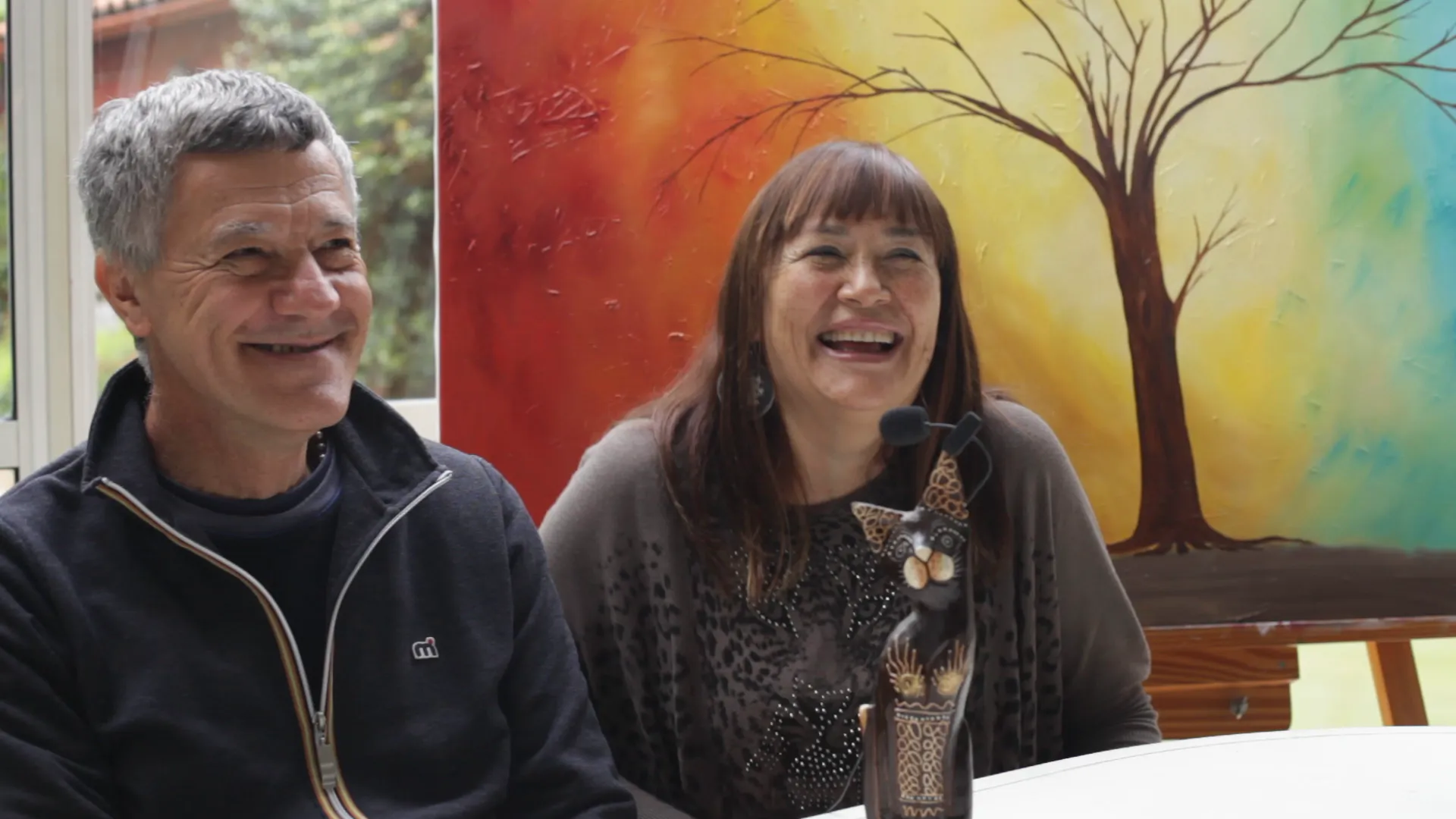
Diego’s mother told me that as she was sitting, she felt strangely still. Suddenly a clear bubble appeared in her belly and expanded until she found herself sitting inside it. In the bubble her body was clear, and quite different from her real body, which was in a lot of pain from the leg. The one inside the bubble did not hurt, and was sitting in meditation. As she looked, she expanded further, and a new bubble appeared, and she went back and forth between herself and the bubble, very happy. Diego’s father, Walter, is a member of Peace Revolution online. He said he could not sit as well as the ladies, but he felt as if he was constantly wrapped in a clear bubble, and that he was resting still inside it.
We asked them how it felt to see their son doing this work, and both of them began to cry. His mother said she was glad that her son had found himself and was doing what he loved, which is good for others. She hoped that one day there will be a meditation center in Argentina, and said she would volunteer there. Walter said he was happy that his son was working on something important. Having felt the benefit himself, he wanted friends, relatives and all humankind to get it too.
Money and sales
At every session Diego and Ana invited people to donate to Peace Revolution and sold souvenirs such as T-shirts, cushions, stickers and CDs. Together, the sales and donations came to about 10,000 baht. That says something about Argentines: when they feel something good from meditation, they want others to have it too.
Spending the money was harder. Argentina’s government had banned its people from buying US dollars. The result is two exchange rates: an official one, which you can only use with a written application to the government, and a black-market rate that is almost twice as expensive. Because every day was packed, we had no chance to change the pesos into dollars. We hoped to change them in Peru, but almost every bank there refused, saying they did not deal in that currency. What we spent on the road came to 2,635 pesos, mostly on petrol, food from the supermarket, parking and tolls.
What stood out
- Warm people. In every room there were smiles, and almost everyone was open to try. Diego and Ana told us this was not normal, and that the smiles were real feeling and not politeness.
- Registration means nothing. Argentines don’t like to sign up. Ten registered at Desplegarte and nearly 30 came; 20 registered at Jupapurá and 70 came. A bigger room and a few more chairs solve this better than a registration list.
- Strong results. At Jupapurá, 80–90% saw a bright light. In Rosario the whole room did.
- Families came along. Diego and Ana brought parents, brothers, sisters and old friends, and some of the best results came from their relatives.
- Interest in the monk’s life. After the session, people asked us more about monastic life than about technique, and in La Plata they wanted to interview us.
- A taste for the exotic. Participants asked for the guided meditation in Thai, then Omjai translated.
- People who travel. Florencia took a full day on a bus for a 40-minute session.
- Local media. A radio station gave us 15 minutes of live meditation on air.
What we would do differently
Diego and Ana kept notes after each session, and some of their suggestions are worth keeping.
- Allow time to arrive. Three sessions started late, because of traffic and a long radio interview, and each time we skipped hanging the banners. One or two sessions a day with enough time in between is better than three.
- Prepare the room. Work out the travel time so there is time to set up the room, and ourselves, before people arrive.
- Have a backup for photography. Keep a second person on standby for video in case someone cannot come.
- Practice with the translator. The translator should sit through the meditation at least once first, to feel more confident.
- Avoid Sunday mornings. At Espacio Rewe it rained, and nobody wants to go out.
- Expect a bigger crowd than the list. Choose the room for the people who will turn up, not the ones who signed up.
The team
- Diego: A former lawyer, Peace Agent, and the one who made this journey possible. He was our MC, translator and driver, and kept the books.
- Ana: A former finance professional and Peace Agent, who looked after registration, materials and the follow-up with participants.
- Omjai: She translated from Thai to Spanish after two years of studying Spanish for exactly that purpose, and helped prepare the meals for the monks.
- LP Prakit: A fellow monk who led the sessions in Thai.
- Román: A Muay Thai teacher in Rosario who was ordained through the IDOP program, and who opened his gym and his network to us.
- Juan Martín Camusso: A Peace Agent who stepped in to film and photograph at Dharam.
- The hosts: Leticia at Banco Columbia, Esteban at Desplegarte, Barbara at Jupapurá, Vanina at Dharam, Guillermo at Shiatsunuad, Gabriela at Centro Shakti and Espacio Rewe, Laura at Fundación Columbia, and Dory in Rosario.
Conclusion
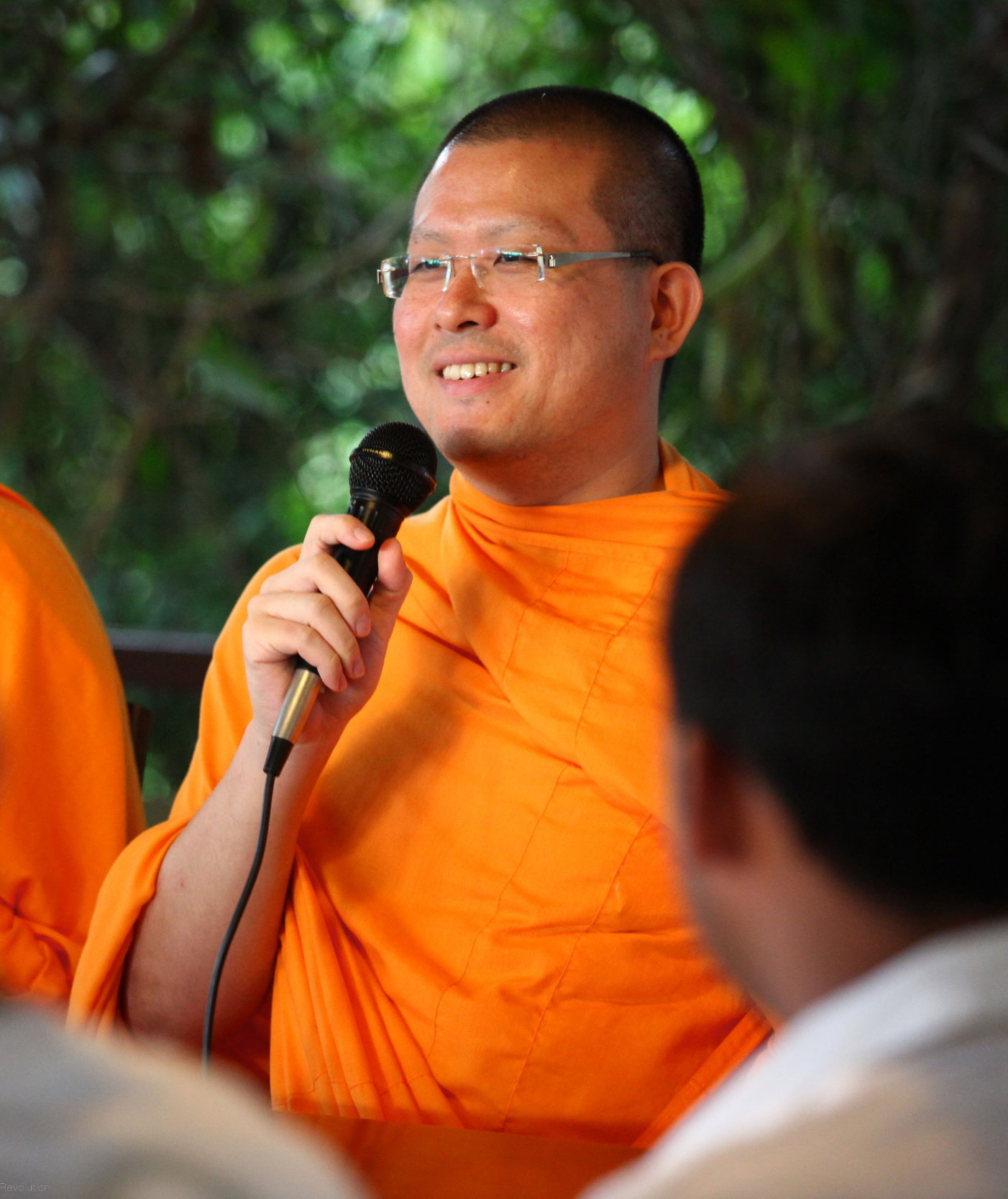
In six days we held ten sessions in four cities, and about 350 people tried meditation. Behind these numbers are two people who left good jobs to look for something that mattered, found Peace Revolution, and in three months built a program that filled corridors.
What impressed me most is how little we needed. A quiet room, a simple method and a warm invitation were enough, and the Argentines did the rest. Within a few minutes of sitting they could feel their own center, and they wanted to share it. Diego’s mother asked whether a meditation center could come to Argentina so that she could volunteer in it. I think it is a good idea.
To Diego and Ana, to Omjai, to Román, Florencia, and to every host who opened a room for us: thank you. You welcomed monks who barely spoke your language, you fed us, drove us, translated for us, and asked for nothing in return. Argentina showed me that one or two committed people are enough to start something in a country. I hope to return, and to see what grows from it.